Economic Patriotism Begins at Home !
India’s relationship with gold is emotional, cultural and deeply personal. Gold is associated with weddings, festivals, security and family savings. That is precisely why Prime Minister Narendra Modi’s appeal asking citizens to avoid or defer non-essential gold purchases for a limited period deserves thoughtful attention and public support.
At first glance, the appeal may appear unusual. But the economic reasoning behind it is straightforward.
India imports most of the gold it consumes, and those imports are paid for in foreign currency. When gold imports rise sharply, they increase pressure on the trade balance, foreign exchange reserves and the rupee. In the present global environment—where oil prices, geopolitical uncertainty and external pressures are already affecting economies worldwide—reducing avoidable imports becomes an important national priority.
India’s gold import bill reportedly touched record levels in FY 2025–26. This means a very large amount of foreign exchange is leaving the country for an imported commodity that, while valuable for households, does not directly create productive domestic capacity.
That is why the Prime Minister’s appeal should not be seen as anti-gold or anti-tradition. It is a temporary call for economic responsibility and collective national awareness.
The message to citizens is simple:
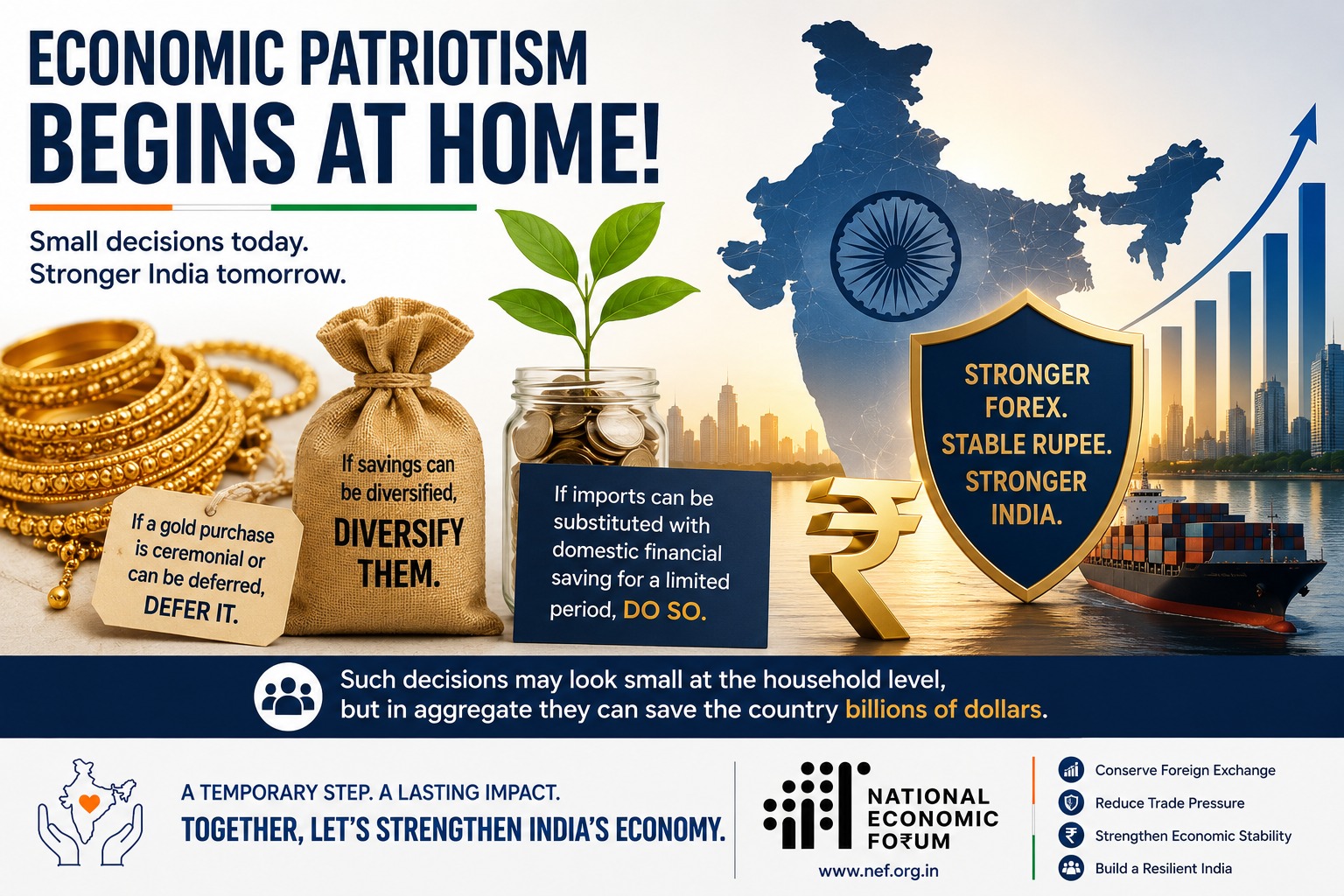
If a gold purchase is ceremonial or can be deferred, defer it. If savings can be diversified, diversify them. If imports can be substituted with domestic financial saving for a limited period, do so. Such decisions may look small at the household level, but in aggregate they can save the country billions of dollars.
This is where economics connects directly with everyday life.
A single family postponing a jewellery purchase may not seem important. But when millions of households take similar decisions, the cumulative national effect becomes significant. Lower demand for imported gold means lower dollar outflow, reduced pressure on the external account, and greater resilience during periods of global volatility.
This is also a reminder that nation-building is not driven only by governments and institutions. Citizens contribute too—sometimes through very ordinary decisions.
Economic patriotism is not merely about slogans. At times, it is reflected in disciplined financial choices that strengthen the country during difficult global conditions.
The Prime Minister’s appeal therefore deserves to be understood in the right spirit:
not as a restriction,not as a rejection of tradition, but as a temporary and practical step in support of India’s economic stability.
Small decisions, when multiplied across India, can create a large national impact.
Jagdip Rana
Executive Director, National Economic Forum
#GoldImports #ForeignExchange #EconomicPolicy #ViksitBharat2047 #NationalEconomicForum #PublicPolicy #AtmanirbharBharat #PMO