
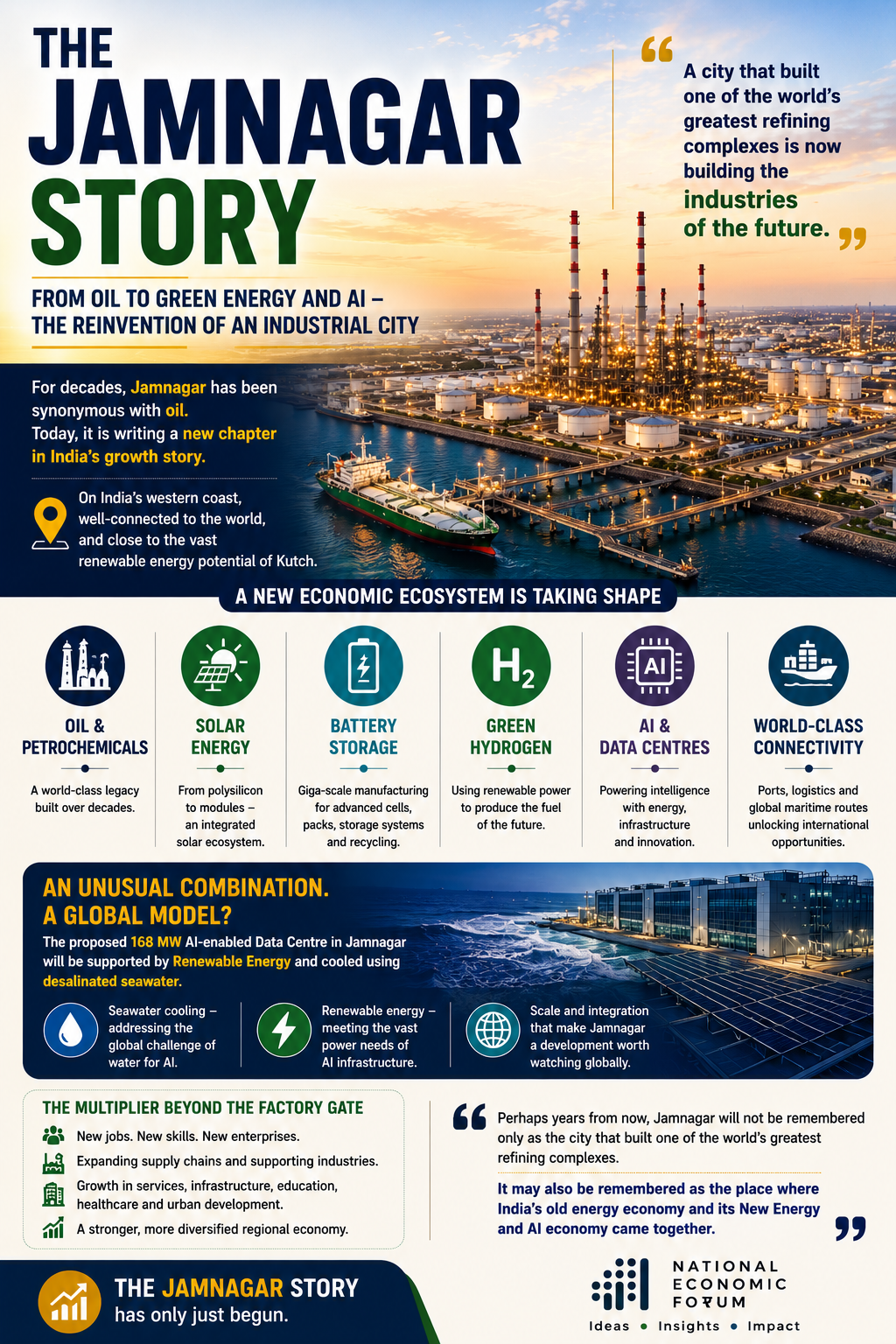
For decades, Jamnagar has been identified with oil. The development of one of the world's largest refining complexes transformed this city on Gujarat's western coast into a globally significant energy and petrochemical centre. But Jamnagar's next chapter may be even more fascinating.
Solar Energy. Battery Storage. Green Hydrogen. AI. Data Centres.
At the centre of this transformation is Reliance Industries and its Dhirubhai Ambani Green Energy Giga Complex, spread over more than 5,000 acres. An integrated New Energy ecosystem covering solar manufacturing, batteries, Green Hydrogen and related technologies is taking shape in Jamnagar.
The story is interesting because Jamnagar is not abandoning its industrial past. It is using the scale, engineering experience and infrastructure created by that past to enter the industries of the future.
Yesterday's Jamnagar processed crude oil. Tomorrow's Jamnagar may increasingly convert sunlight into electricity, store energy in batteries and use renewable power to produce Green Hydrogen.
And now, AI is entering the story. Meta and Reliance have announced a 168 MW AI-enabled Data Centre in Jamnagar. The facility is expected to be supported by Renewable Energy and cooled using desalinated seawater.
There is something particularly interesting here. Across the world, the rapid growth of AI is creating a new challenge: Data Centers require enormous quantities of electricity and cooling. At Jamnagar, energy, seawater and computing are being brought together at industrial scale.
It may not be the world's first experiment with seawater-cooled or renewable-powered Data Centers. But the scale and integration of the Jamnagar model make it a development worth watching globally.
Geography explains part of the story. Jamnagar sits on India's western coast, close to the Gulf of Kutch and the Arabian Sea. It has access to global maritime routes and Gujarat's powerful port-led industrial ecosystem. Nearby Kutch is emerging as one of India's most important Renewable Energy geographies. The possibilities are striking.
Oil. Petrochemicals. Solar Energy. Batteries. Green Hydrogen. AI. Data Centres.
When so many economic engines begin to converge in one geography, the transformation rarely remains confined within factory walls. Supply chains expand. Skilled employment grows. New services emerge. The economic identity of a city is beginning to change.
That is what makes The Jamnagar Story so interesting.
A city known globally for refining oil is now entering India's New Energy story. A traditional energy center is becoming part of the AI infrastructure economy. Perhaps, years from now, Jamnagar will not be remembered only as the city that built one of the world's greatest refining complexes.It may also be remembered as the place where India's old energy economy and its New Energy and AI economy came together.
The Jamnagar Story has only just begun.
Jagdip Rana
Executive Director, National Economic Forum