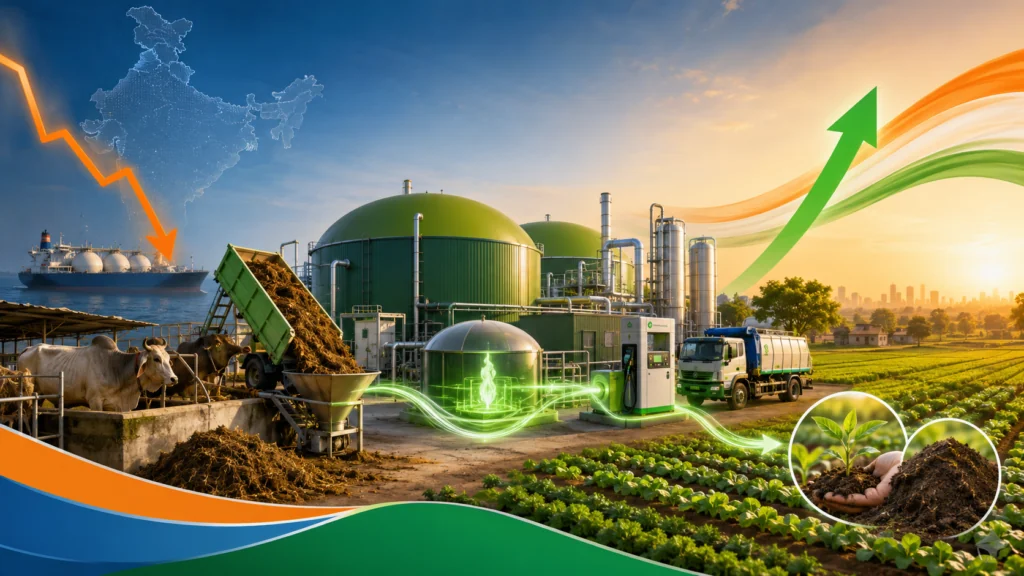
For decades, India's farms and cattle sheds have quietly produced a resource the country never fully valued. Cattle dung was burnt as cheap fuel or left to rot in open pits; crop residue was set alight in fields each winter, choking cities in smoke; municipal organic waste piled up in landfills. This was agricultural and animal wealth going to waste, quite literally, even as India spent scarce foreign exchange importing natural gas and LPG. GOBARdhan - Galvanizing Organic Bio-Agro Resources Dhan, was conceived to close that gap.
August 2026, the Union Cabinet approved it as the National Circular Bioenergy Scheme, with a ten-year outlay of ₹23,731 crore running from FY2026-27 to FY2035-36. Administered by the Ministry of Petroleum and Natural Gas, the revamped scheme folds in earlier programmes such as SATAT and the Market Development Assistance Scheme into one unified framework for compressed biogas (CBG).
The economic logic is compelling. The government expects nearly a ten-fold jump in domestic CBG production, alongside projected forex savings exceeding ₹40,000 crore and displacement of roughly 10 million tonnes of fossil fuel. A mandated CBG blending obligation for city gas distributors rising from 3% in FY27 to 5% by FY29 combined with an assured administered price of about ₹2,110 per MMBTU (Metric Million British Thermal Unit), gives investors the price certainty long missing from this sector. Officials also point to around 1.5 lakh potential jobs and 250 million tonnes of organic fertiliser as co-benefits, offering farmers both extra income from selling feedstock and a cheaper alternative to chemical fertiliser.
Yet the scheme's own numbers reveal the challenge ahead: of roughly 1,900 registered CBG plants nationwide, only about 200 are actually operational, a commissioning gap that plagued SATAT before it. Feedstock aggregation, financing for small entrepreneurs, and pipeline connectivity remain weak links.
The scheme’s ambition is now matched by real capital and pricing certainty. Looking forward: Whether India converts registrations into reality or just keeps it as a slogan.